


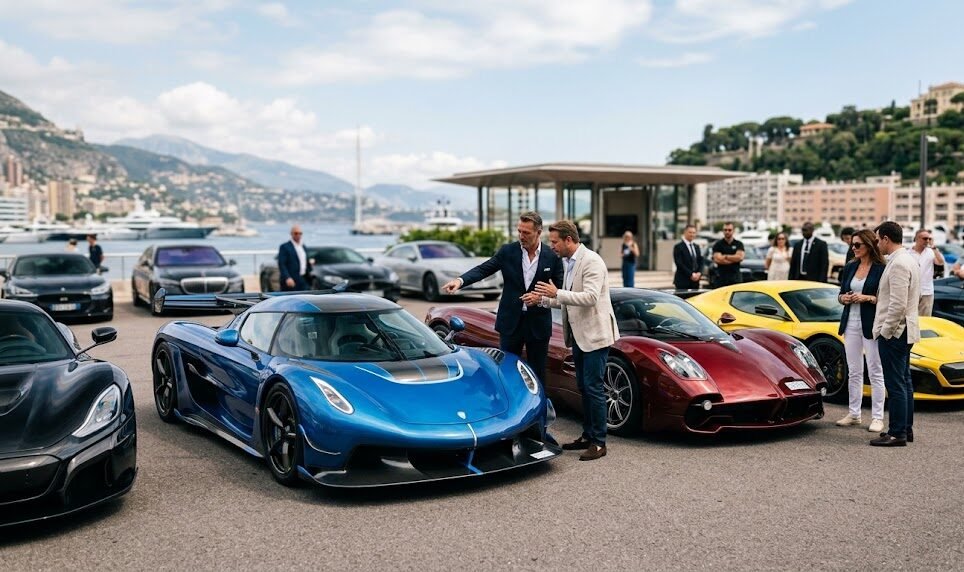
In the world of ultra-wealthy collectors, buying a hypercar is no longer as simple as walking into a dealership and writing a check.
Money helps, of course. But in 2026, even billionaires are discovering that some of the world’s most exclusive hypercars are nearly impossible to obtain. Waiting lists stretch for years, production numbers are measured in dozens rather than thousands, and manufacturers increasingly hand-pick customers rather than accepting whoever offers the highest price.
The result is a fascinating battle unfolding behind closed doors.
Private collectors, technology entrepreneurs, royalty, hedge fund managers, celebrities, and automotive investors are competing for machines that represent the absolute peak of engineering and exclusivity. These vehicles are not merely transportation devices. They are rolling works of art, technological showcases, and status symbols capable of appreciating in value before they even leave the factory.
In a world where luxury is becoming increasingly digital, hypercars remain one of the last truly physical displays of automotive excellence.
Here are the ten hypercars that billionaires around the globe are desperately trying to add to their collections in 2026.
1. Bugatti Tourbillon
When Bugatti announced the Tourbillon, the automotive world immediately paid attention.
Replacing the legendary Chiron was never going to be easy, yet Bugatti somehow delivered a successor that feels even more extraordinary. Combining a naturally aspirated V16 engine with advanced hybrid technology, the Tourbillon represents a bold statement in an increasingly electrified world.
The design balances timeless elegance with futuristic engineering.
Production numbers remain extremely limited, ensuring that demand far exceeds supply.
For collectors, owning a Tourbillon is less about transportation and more about securing a piece of automotive history.
2. Koenigsegg Jesko Absolut
If speed remains the ultimate automotive currency, the Jesko Absolut is among the richest machines ever created.
Designed with a singular focus on maximizing aerodynamic efficiency and top-speed potential, it represents Koenigsegg’s vision of ultimate performance.
The engineering is astonishing.
Every component appears optimized for extracting every possible kilometer per hour.
Collectors view the Jesko Absolut as one of the last pure expressions of internal-combustion hypercar insanity.
That alone makes it highly desirable.
3. Rimac Nevera R
Electric hypercars have matured rapidly.
The Nevera R demonstrates just how far the technology has advanced.
Delivering mind-bending acceleration and advanced software systems, the Croatian masterpiece has become one of the most technologically sophisticated vehicles ever built.
Performance figures almost sound fictional.
Yet beyond the numbers, the Nevera R represents the future of extreme automotive performance.
Billionaires seeking cutting-edge innovation are paying very close attention.
4. Pagani Utopia Roadster
Pagani has always approached automotive design differently.
While many manufacturers emphasize raw performance statistics, Pagani focuses on artistry, craftsmanship, and emotional connection.
The Utopia Roadster embodies that philosophy perfectly.
Every detail feels handcrafted and deeply personal.
Collectors often describe Pagani ownership as comparable to owning a rare sculpture.
Its exclusivity only increases the appeal.
5. McLaren W1
As the spiritual successor to iconic models such as the F1 and P1, the W1 arrived carrying enormous expectations.
Fortunately, McLaren delivered.
The W1 combines Formula One-inspired technology with breathtaking performance and aggressive aerodynamics.
Demand immediately exploded.
Collectors recognized its significance from day one.
Many industry experts already consider it one of the most important hypercars of the decade.
6. Ferrari F80
Ferrari’s flagship hypercars rarely remain available for long.
The F80 continues that tradition.
Combining racing technology, hybrid power, and unmistakable Ferrari design language, it has become one of the most sought-after vehicles in the world.
For many collectors, owning Ferrari’s latest halo car represents a milestone achievement.
Demand far exceeds available production slots.
As a result, invitations to purchase have become nearly as valuable as the cars themselves.
7. Aston Martin Valhalla
The Valhalla bridges the gap between road cars and Formula One technology.
Its aggressive styling, hybrid powertrain, and advanced aerodynamics create an impressive package that appeals to performance enthusiasts and collectors alike.
Aston Martin’s growing association with Formula One has further elevated the model’s desirability.
The Valhalla represents a significant moment in the brand’s evolution.
Many collectors believe it could become one of Aston Martin’s most important modern vehicles.
8. Lamborghini Revuelto
Purists initially worried about Lamborghini’s transition toward hybrid technology.
The Revuelto quickly silenced those concerns.
Retaining a naturally aspirated V12 while integrating electrification, the car preserves Lamborghini’s dramatic character while embracing modern performance expectations.
The result feels both familiar and revolutionary.
Its combination of sound, speed, and visual drama continues attracting wealthy buyers worldwide.
Production demand remains exceptionally strong.
9. Hennessey Venom F5 Revolution
American hypercars have evolved significantly.
The Venom F5 Revolution demonstrates that the United States can compete directly with Europe’s most prestigious manufacturers.
Focused heavily on extreme performance, it offers an uncompromising driving experience.
Its rarity contributes heavily to its appeal.
Collectors seeking something different from the usual European offerings frequently place the Venom F5 high on their wish lists.
10. Mercedes-AMG ONE
Few hypercars blur the line between race car and road car as dramatically as the AMG ONE.
Powered by technology derived directly from Formula One, it represents one of the most ambitious automotive projects ever attempted.
The engineering challenges were immense.
The final result is equally extraordinary.
Owning an AMG ONE is not merely about possessing a hypercar.
It is about owning a piece of Formula One history adapted for public roads.
Why Hypercars Have Become Investment Assets
A fascinating shift has occurred in recent years.
Many collectors no longer view hypercars purely as passion purchases.
Instead, they increasingly treat them as alternative investments.
Limited production numbers, global demand, and brand prestige create conditions where certain vehicles appreciate significantly over time.
Some hypercars increase in value before delivery.
Others become auction sensations within a few years.
While financial returns are never guaranteed, the investment narrative continues attracting wealthy buyers.
The combination of enjoyment and potential appreciation is difficult to resist.
Exclusivity Is More Valuable Than Speed
Interestingly, the most important hypercar metric in 2026 is not horsepower.
It is exclusivity.
Many of these vehicles produce performance levels beyond what public roads can realistically accommodate.
Collectors understand this.
What truly matters is rarity.
Owning a vehicle that only a handful of people worldwide possess creates a unique sense of distinction.
Scarcity has become the ultimate luxury.
And manufacturers know it.
The Rise of Hybrid Hypercars
One trend dominates the list.
Electrification.
Hybrid technology now appears in many of the world’s most desirable hypercars.
Rather than reducing excitement, electrification is enhancing performance.
Instant torque, improved efficiency, and advanced energy recovery systems are allowing engineers to push boundaries further than ever before.
The modern hypercar is becoming a fusion of traditional engineering and digital innovation.
The future is arriving fast.
What Billionaires Really Want
It is easy to assume that billionaires purchase hypercars purely to show off.
Reality is more nuanced.
Many collectors genuinely appreciate engineering excellence, automotive history, and design innovation.
They seek experiences unavailable elsewhere.
A hypercar represents exclusivity, craftsmanship, and technological achievement compressed into a single machine.
For some buyers, it is art.
For others, it is an investment.
For many, it is both.
Conclusion
The hypercar market in 2026 is more competitive, exclusive, and fascinating than ever before.
Manufacturers continue pushing technological boundaries while carefully limiting production to maintain desirability. As a result, demand has reached extraordinary levels.
From the Bugatti Tourbillon and Ferrari F80 to the Rimac Nevera R and McLaren W1, today’s hypercars are far more than performance machines.
They are symbols of innovation, exclusivity, and ambition.
In a world where billionaires can seemingly buy anything, these ten hypercars remain among the few possessions worth fighting for.
Frequently Asked Questions (FAQ)
What is a hypercar?
A hypercar is an ultra-high-performance vehicle that represents the pinnacle of automotive engineering, technology, speed, and exclusivity.
Why are hypercars so expensive?
Hypercars use advanced materials, cutting-edge engineering, limited production numbers, and extensive research and development, contributing to extremely high prices.
Are hypercars good investments?
Some limited-production hypercars have appreciated significantly in value, although investment performance is never guaranteed.
What is the rarest hypercar in 2026?
Rarity varies by model, but vehicles with extremely limited production runs often become the most exclusive and desirable.
Are electric hypercars becoming popular?
Yes. Models like the Rimac Nevera R demonstrate that electric hypercars can compete with and even surpass traditional combustion-powered rivals.
Why do manufacturers limit production?
Limited production increases exclusivity, strengthens brand prestige, and helps maintain long-term desirability among collectors.

1 Comment
Pingback: Hypercar Auction Breaks Records as Rare Model Sells for $12 Million - Halosumut AutoNet