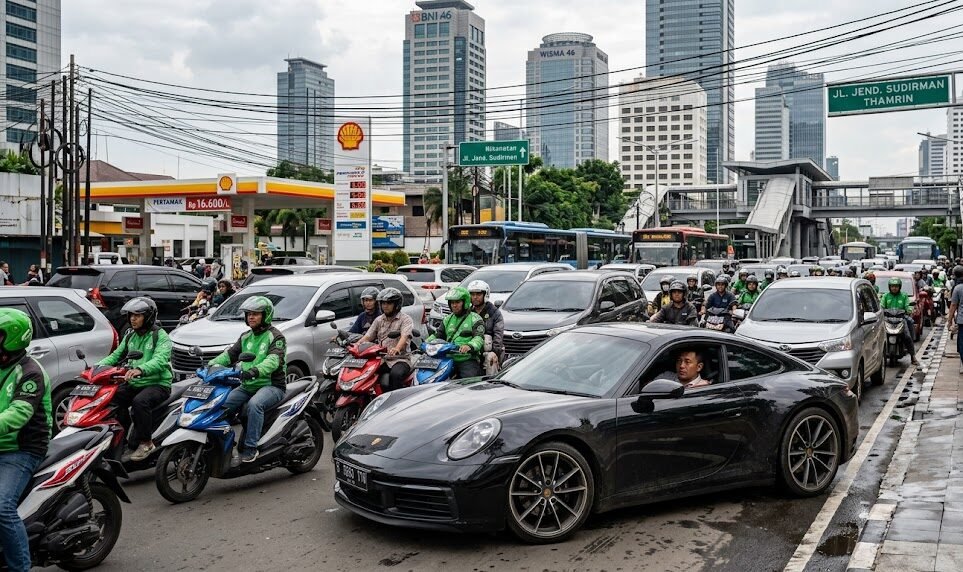
HALOSUMUT, AUTONET – Gliding down Jakarta’s wide avenues or pulling up to exclusive malls and five-star hotels, luxury cars like Rolls-Royce, Ferrari, Lamborghini, Bentley, and Porsche turn heads everywhere they go. They are not just vehicles; they are moving statements of wealth, success, and status.
But what almost no one sees is the massive, ongoing financial commitment hidden behind those shiny paint jobs, premium leather interiors, and roaring engines. In Indonesia’s capital, owning one of these beauties is far more expensive than just the price tag you pay at the dealership — it is a financial lifestyle that only a tiny fraction can truly afford, and the numbers will absolutely blow your mind.
The first big shock comes right when you sign the papers. Unlike standard cars, luxury models here are hit with layers of taxes and import duties that can nearly double their base price. A brand-new Rolls-Royce Phantom, for example, starts at around Rp 12 billion overseas, but by the time it reaches Jakarta’s roads, the “on-the-road” price jumps to between Rp 20 and Rp 24 billion.
This huge difference comes from PPnBM (Luxury Goods Sales Tax) which reaches 70–125% for engines over 3,000 cc, plus import duties, VAT, and administrative fees. Even “affordable” supercars like a Ferrari Roma or Lamborghini Huracán, which cost about Rp 4–5 billion abroad, end up priced at Rp 9–11 billion locally. It is not just buying a car — it is paying a premium just to bring luxury into the country.
Once you own it, the bills keep coming, and the most famous one is the annual road tax. In Jakarta, tax is calculated based on the official assessed value of the vehicle and engine size, plus a progressive rate if you own more than one car under the same name.
For a Phantom, that means Rp 200 to 414 million every single year — enough to buy a brand-new small city car annually, or even a modest house in some areas of Indonesia. A Ferrari 812 Superfast or Lamborghini Aventador isn’t far behind, with yearly taxes hitting Rp 180–250 million.
Even “entry-level” luxury SUVs like the Bentley Bentayga or Porsche Cayenne Turbo cost Rp 40–80 million just to keep registered and legal on the road. Paying late? Expect a fine of up to 25% on top — another massive extra cost.
Then there is maintenance, and this is where things get truly crazy. You cannot take a Rolls-Royce or a Ferrari to any regular workshop. All service, repairs, and parts must be done at official authorized centers, and every single item is priced like a luxury product itself.
A basic oil change and routine service for a Phantom costs Rp 80–150 million — more than the entire price of many family cars. Changing brake pads and discs on a supercar? Around Rp 50–90 million. Even simple things: a set of original tires runs Rp 40–70 million, and if you scratch the paint or crack a mirror, repairs easily go into tens of millions.
Parts are mostly imported, so shipping and taxes add even more. And because these cars use highly specialized technology and materials, there are almost no cheaper alternatives — you pay full price or your warranty is void.
Fuel is another big expense, though surprisingly not the largest. Most of these cars have huge engines — 5.0L, 6.0L, even 6.75L V12s — and in Jakarta’s stop-start traffic, fuel consumption is terrible. You will be lucky to get 3–5 km per liter, meaning a full tank of premium Pertamax Turbo costs Rp 2–4 million and lasts only a few hundred kilometers.
For daily drivers, that’s Rp 15–30 million spent on fuel every month, just to move from one place to another. Electric luxury models like the Rolls-Royce Spectre or Porsche Taycan cut fuel costs to almost zero, but they still carry all the same tax, insurance, and maintenance bills — and their batteries cost billions to replace later.
Insurance is non-negotiable, and premiums are equally mind-blowing. Standard cars cost 2–4% of their value per year to insure; luxury cars in Jakarta are 5–8% or even more, because repair costs are so high and parts are rare. Insuring a Rp 20 billion Phantom means paying Rp 1–1.6 billion annually just for coverage.
Even a Rp 5 billion Lamborghini costs Rp 250–400 million a year. Some owners choose to self-insure, meaning they pay everything out of pocket if there’s an accident, theft, or damage — a risky choice, but even that is cheaper than the premium. And many insurers in Jakarta will not even cover these cars unless you store them in a secure garage and have a good driving record.
Parking and security are often overlooked but add up fast. You cannot park a Rp 10+ billion car on the street or in a regular public lot. Most owners rent private secure parking spots in elite buildings, apartments, or malls — costing Rp 3–10 million per month per car. Many also install 24-hour CCTV, special locks, tracking systems, and hire private security for their garages.
If you take it out, valet parking at top hotels or clubs costs extra, and you always have that nagging fear: what if someone bumps it, scratches it, or spills something? In Jakarta’s busy, chaotic traffic, the risk of minor damage is high, and every small issue costs a fortune to fix perfectly.
Depreciation is the silent cost no one talks about. Unlike classic cars that might go up in value, most modern luxury vehicles lose money fast. In the first three years alone, a supercar or ultra-luxury model loses 40–60% of its original value, simply because they are no longer “new.”
A car you bought for Rp 15 billion might be worth only Rp 6–8 billion after three years, and reselling is hard — there are very few buyers, and paperwork and taxes make transactions complicated. Even well-kept examples struggle to hold value, meaning every kilometer you drive is literally burning money. Many owners keep them for show or collection, rarely driving them, just to slow down this financial loss.
So who actually owns these cars in Jakarta? It is almost entirely top business owners, conglomerate families, famous celebrities, and high-ranking executives — people whose annual income is in hundreds of billions or trillions of rupiah. For them, the cost is not a burden, but part of the price of belonging to the absolute top tier of society. They see these cars as investments in image, connections, and status, not just transport.
For everyone else, even wealthy professionals, the numbers are simply impossible. You might earn Rp 20–30 million a month and think you are well-off, but that would barely cover the insurance or tax for one year on a single luxury car.
The trend is changing a little, though. Some buyers now choose slightly older models, or electric luxury cars which get tax breaks from the Jakarta government. Others opt for high-end brands like Lexus, Mercedes-Maybach, or Range Rover, which are expensive but far cheaper to run and maintain than the ultra-exotic brands.
Yet the magic of a Rolls-Royce or Ferrari remains unmatched. In Jakarta, where status is everything, the desire to own one is stronger than ever — even when you know it will drain your bank account faster than almost anything else you could buy.
At the end of the day, driving one of these masterpieces is an experience like no other. The comfort, power, craftsmanship, and attention you get are priceless. But behind the beauty, there is a harsh reality: owning a luxury car in Jakarta is not just expensive — it is financially extreme.
It is a lifestyle reserved only for those ready to pay millions, hundreds of millions, or even billions of rupiah every year, just to keep that beautiful machine running and legal. For most of us, admiring them from the sidewalk is the only way to enjoy them — and honestly, that might be the smartest financial choice of all.
FAQ
Q: What is the biggest cost of owning a luxury car in Jakarta?
A: The largest ongoing expenses are annual tax, regular maintenance, and insurance. Combined, these can easily reach 300–600 million rupiah per year for top-tier models, far more than the cost of buying many standard cars.
Q: Are electric luxury cars cheaper to own?
A: Yes and no. You save almost entirely on fuel, and Jakarta gives big tax breaks or even zero tax for electric vehicles. However, maintenance, insurance, battery replacement, and service costs remain just as high as petrol models, so savings are limited.
Q: Can I avoid the high taxes?
A: No — taxes are strictly enforced by the Jakarta government, based on official vehicle value and engine size. There are no legal loopholes. Buying older cars reduces tax slightly, but not by much.
Q: How much does it cost to insure a Rp 10 billion car?
A: Typically Rp 500 million to 1 billion rupiah per year, or roughly 5–10% of the car’s assessed value. Many owners choose partial coverage or self-insurance to cut costs, but that carries big risks.
Q: Do luxury cars hold their value well in Jakarta?
A: Generally no. Most lose 40–60% of their value in the first 3–4 years. Only rare, limited-edition, or classic models might appreciate, but those are extremely hard to find and very expensive to buy.




2 Comments
Pingback: Best SUV for Flooded Indonesian Streets? We Tested 7 Popular Models - Halosumut AutoNet
Pingback: The Silent Luxury Trend: Why Rich Drivers Are Switching to EV Sedans - Halosumut AutoNet