


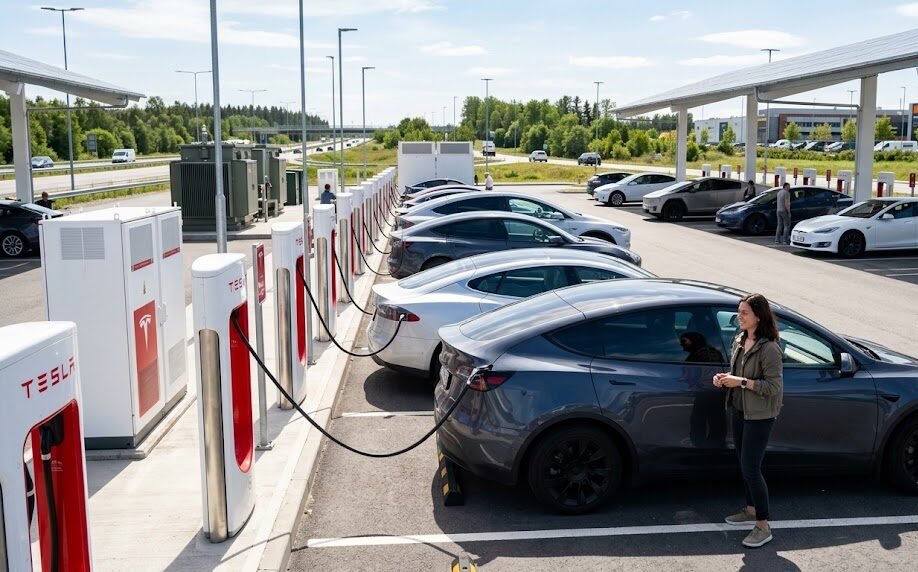
HALOSUMUT AUTONET – As electric vehicle (EV) adoption accelerates worldwide, charging infrastructure has become one of the most important factors influencing consumer confidence. In 2026, the Tesla Supercharger Network continues to lead the industry, setting a global benchmark for speed, reliability, accessibility, and user experience.
Originally designed to support Tesla owners, the Supercharger ecosystem has evolved into one of the world’s most advanced fast-charging networks. Its extensive coverage, intelligent charging technology, and expanding compatibility with multiple EV brands are helping shape the future of sustainable transportation.
Industry analysts believe that a dependable charging network is now just as critical as battery range, making charging infrastructure a key competitive advantage in the rapidly growing electric mobility market.
Extensive Charging Coverage Enhances Long-Distance Travel
One of the Supercharger Network’s greatest strengths is its widespread deployment across highways, metropolitan areas, and strategic travel corridors.
The extensive infrastructure allows EV drivers to undertake long-distance journeys with greater confidence, reducing concerns about finding reliable charging stations.
By strategically locating chargers near shopping centers, restaurants, hotels, and major transportation routes, Tesla has improved convenience while minimizing travel interruptions.
Ultra-Fast Charging Improves Everyday Convenience
Charging speed remains one of the primary considerations for EV owners.
Tesla’s latest Supercharger technology significantly reduces charging times, allowing compatible vehicles to recover substantial driving range within a relatively short stop.
This faster charging capability makes electric vehicles increasingly practical for commuters, business travelers, and families taking longer road trips.
Combined with intelligent battery management systems, the charging process is optimized to balance speed, battery health, and overall efficiency.
Smart Software Creates a Seamless User Experience
Beyond hardware, Tesla integrates sophisticated software throughout its charging ecosystem.
Drivers benefit from automatic route planning, real-time charger availability, navigation-assisted charging stops, and dynamic battery preconditioning that prepares the battery for optimal charging performance before arriving at a station.
This seamless integration simplifies trip planning while reducing waiting times and improving charging efficiency.
Expanding Compatibility Strengthens the EV Ecosystem
In recent years, Tesla has expanded access to portions of its charging infrastructure for non-Tesla electric vehicles in selected markets.
This broader compatibility supports industry-wide EV adoption by providing more charging options for drivers regardless of vehicle manufacturer.
As interoperability becomes increasingly important, charging networks capable of serving multiple brands are expected to play a vital role in accelerating the transition toward electric mobility.
Charging Infrastructure Is Becoming a Competitive Differentiator
Automotive manufacturers are increasingly recognizing that success in the EV market depends not only on vehicle performance but also on the quality of the charging experience.
Reliable infrastructure encourages greater consumer confidence, particularly among first-time EV buyers who may still have concerns about long-distance travel and charging availability.
As competition intensifies, charging ecosystems are becoming an essential component of overall brand value.
Renewable Energy Integration Supports Sustainability
Tesla continues exploring ways to integrate renewable energy solutions into its charging network.
Several charging locations incorporate solar energy generation and battery storage systems designed to improve energy efficiency while reducing reliance on conventional power sources.
These initiatives align with broader efforts to create a cleaner and more sustainable transportation ecosystem.
Future Charging Networks Will Be Smarter
Artificial intelligence and predictive analytics are expected to play a larger role in future charging infrastructure.
Intelligent systems may optimize energy distribution, forecast station demand, recommend optimal charging times, and automatically balance network loads during peak usage.
These innovations could further improve charging reliability while reducing operational costs for network operators.
As governments worldwide continue investing in electric mobility and consumers increasingly embrace zero-emission transportation, the Tesla Supercharger Network remains one of the strongest examples of how advanced infrastructure can accelerate the global shift toward sustainable transportation.
Key Advantages of the Tesla Supercharger Network
| Feature | Benefit |
|---|---|
| Extensive Charging Coverage | Supports convenient long-distance EV travel |
| Ultra-Fast Charging | Reduces charging time significantly |
| Smart Route Planning | Optimizes navigation and charging efficiency |
| High Reliability | Consistent charging performance across locations |
| Multi-Brand Compatibility | Expands charging access for more EV drivers |
| Renewable Energy Integration | Supports cleaner and more sustainable operations |
Fast-Charging Infrastructure Is Driving the Future of Electric Mobility
As electric vehicle adoption continues to expand across global markets, charging infrastructure has become a defining factor in the ownership experience. Consumers increasingly expect charging networks to deliver the same level of reliability and convenience traditionally associated with fuel stations.
The Tesla Supercharger Network demonstrates how advanced charging technology, intelligent software, and strategic infrastructure investment can work together to remove barriers to EV adoption. With continued innovation in charging speeds, renewable energy integration, and cross-brand compatibility, fast-charging networks are expected to remain at the center of the automotive industry’s transition toward an all-electric future.
