


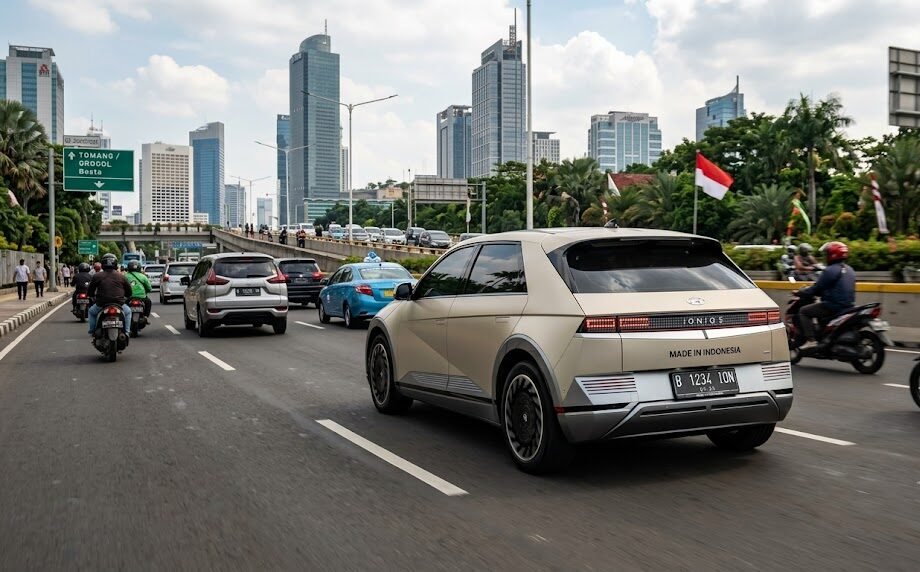
The Hyundai IONIQ 5, manufactured in Indonesia, continues to play a strategic role in accelerating the development of Southeast Asia’s electric vehicle (EV) industry. Produced at Hyundai Motor Manufacturing Indonesia (HMMI), the award-winning battery electric vehicle demonstrates Indonesia’s growing capability to manufacture globally competitive EVs while supporting the country’s long-term vision of becoming a regional automotive production hub.
As governments and consumers increasingly embrace sustainable mobility, the locally produced IONIQ 5 represents an important milestone in Indonesia’s transition toward clean transportation and advanced automotive manufacturing.
Industry analysts believe the vehicle’s success reinforces Indonesia’s position as one of Southeast Asia’s emerging leaders in electric vehicle production.
Indonesia Expands Its Role in Regional EV Manufacturing
Indonesia has rapidly become one of the region’s most attractive destinations for electric vehicle investment.
Supported by abundant nickel resources, expanding battery supply chains, favorable government policies, and growing industrial infrastructure, the country has attracted significant investment from global automotive manufacturers. The production of the Hyundai IONIQ 5 reflects confidence in Indonesia’s ability to meet international manufacturing standards while serving both domestic and export markets.
This development also strengthens Indonesia’s ambition to become an integrated electric vehicle ecosystem, covering raw materials, battery production, vehicle assembly, and supporting industries.
Modern Technology Meets Sustainable Mobility
The Hyundai IONIQ 5 showcases Hyundai’s latest electric mobility technologies.
Built on the company’s dedicated Electric Global Modular Platform (E-GMP), the vehicle offers rapid charging capability, spacious interior design, advanced driver assistance systems (ADAS), and impressive driving efficiency. These features position the IONIQ 5 as a competitive option in the growing global EV market.
Its production in Indonesia demonstrates the country’s ability to manufacture technologically advanced vehicles that meet international consumer expectations.
Export Opportunities Continue to Grow
Demand for electric vehicles continues rising across Southeast Asia and international markets.
The Indonesia-made Hyundai IONIQ 5 has become an important export product, supporting Hyundai’s regional distribution strategy while enhancing Indonesia’s reputation as a reliable manufacturing base. Expanding exports contribute to foreign exchange earnings, industrial growth, and stronger integration into the global automotive supply chain.
Growing international demand also creates opportunities for local suppliers to participate in higher-value manufacturing activities.
Local Industry Benefits from EV Development
The expansion of electric vehicle manufacturing generates positive effects throughout Indonesia’s industrial ecosystem.
Investment in EV production encourages the growth of battery manufacturers, component suppliers, logistics providers, software developers, engineering services, and technical workforce development. These interconnected industries contribute to broader economic growth while fostering innovation across the automotive sector.
Continuous collaboration between manufacturers, educational institutions, and government agencies also helps strengthen Indonesia’s long-term competitiveness in advanced manufacturing.
Infrastructure and Innovation Support Future Growth
The continued expansion of charging infrastructure remains an essential factor in accelerating EV adoption.
Public and private sector investments in charging stations, renewable energy integration, battery recycling, and smart mobility solutions are creating a more supportive ecosystem for electric vehicle users. Advances in battery technology and digital connectivity are also expected to improve vehicle performance, charging efficiency, and ownership experience.
These developments position Indonesia to remain competitive as the regional EV market continues evolving.
Southeast Asia’s EV Industry Enters a New Era
Electric vehicle adoption is transforming the automotive landscape across Southeast Asia.
Governments throughout the region are introducing policies that encourage cleaner transportation, reduce carbon emissions, and promote investment in sustainable manufacturing. Indonesia’s success in producing vehicles such as the Hyundai IONIQ 5 demonstrates how local manufacturing can contribute to regional industrial development while supporting global sustainability goals.
As technological innovation continues advancing, Indonesia-made electric vehicles are expected to play an increasingly important role in shaping the future of mobility across Southeast Asia and beyond.
The global shift toward electric mobility is encouraging automakers to diversify manufacturing locations closer to emerging consumer markets. Indonesia’s strategic location, competitive labor force, and abundant battery raw materials have positioned the country as one of Asia’s fastest-growing electric vehicle production centers.
In addition to vehicle assembly, Indonesia is investing heavily in battery manufacturing, mineral processing, and renewable energy integration to build a complete EV supply chain. These investments are expected to reduce production costs, strengthen export competitiveness, and support long-term industrial sustainability.
Looking ahead, experts anticipate continued growth in Indonesia’s EV ecosystem through the adoption of solid-state batteries, vehicle-to-grid (V2G) technology, AI-powered manufacturing, and smart mobility solutions. As global demand for electric vehicles continues increasing, the Indonesia-made Hyundai IONIQ 5 stands as a strong example of the country’s expanding influence in the international automotive industry.

1 Comment
Pingback: CARSOME Accelerates Southeast Asia's Digital Used Car Market with Trusted Automotive Innovation - Halosumut AutoNet