


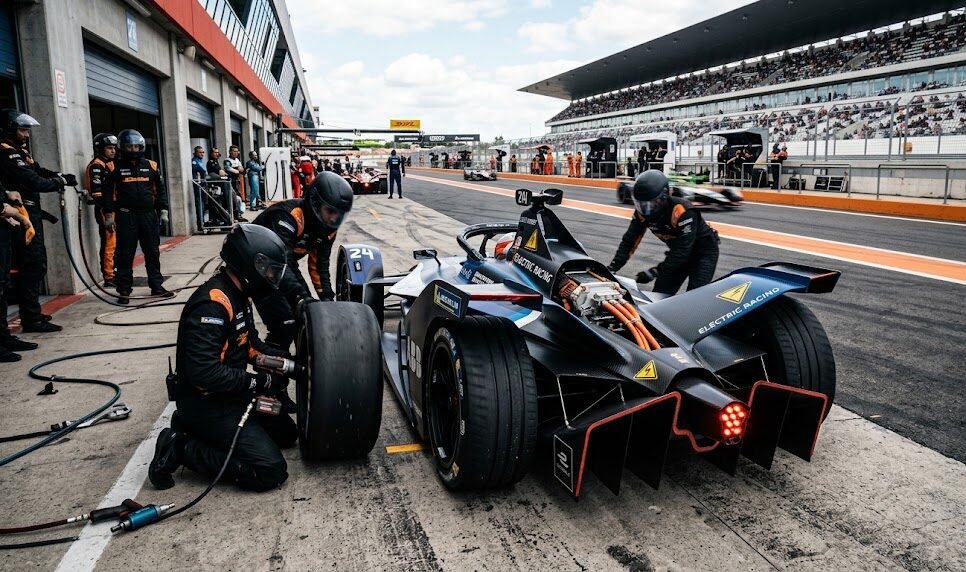
The first time I stood beside an electric race car, something felt missing. There was no thunderous engine roar shaking the ground, no smell of fuel hanging in the air, and no dramatic revving before launch. Yet when the lights went green, the car exploded forward with a level of acceleration that felt almost unreal. That moment completely changed my perspective on racing technology.
For decades, motorsport innovation revolved around extracting more power from internal combustion engines. Engineers chased horsepower through turbochargers, aerodynamics, lightweight materials, and mechanical refinement. Today, however, a new era is emerging. Electric motorsport technology is proving that speed, performance, and innovation do not depend solely on gasoline.
From Formula E circuits to electric rallycross championships, battery-powered race cars are becoming advanced laboratories on wheels. The technologies developed in racing are increasingly influencing road cars, energy systems, and sustainable transportation worldwide.
SEE ALSO >>> Inside Motorsport Engineering: Aerodynamics, CFD, and Race Car Development Explained
The Rise of Electric Motorsport
Electric racing was once viewed as a niche experiment. Critics argued that battery-powered vehicles lacked the excitement, endurance, and emotional appeal of traditional race cars.
The reality turned out differently.
Within a decade, electric motorsport evolved into one of the fastest-growing sectors in the racing industry. Manufacturers recognized that electric competition offered a perfect environment for testing emerging technologies under extreme conditions.
Today, major automotive brands invest heavily in electric racing programs because every lap generates valuable data that can improve future consumer vehicles.
Understanding Electric Motorsport Technology
Electric race cars rely on a fundamentally different engineering philosophy compared to traditional combustion-powered machines.
Instead of converting fuel into mechanical power through explosions inside cylinders, electric race cars transform stored electrical energy into immediate torque using sophisticated motors and power electronics.
The key components include:
- High-performance battery packs
- Electric motors
- Inverters
- Power management software
- Regenerative braking systems
- Advanced thermal management
Together, these systems create a highly efficient performance platform capable of astonishing acceleration and precision.
Batteries: The Heart of Electric Racing
If the electric motor is the muscle, the battery is the heart.
Battery technology remains the most critical area of development in electric motorsport. Engineers constantly seek improvements in energy density, charging speed, safety, and weight reduction.
Modern electric race batteries utilize advanced lithium-ion chemistry designed to withstand extreme loads while delivering consistent power output.
Several key challenges define battery development:
Energy Density
Higher energy density allows more power storage without increasing weight. This directly impacts race distance and performance.
Thermal Management
Extreme racing conditions generate enormous heat. Maintaining optimal battery temperatures is crucial for reliability and efficiency.
Charging Speed
Rapid charging technologies continue to improve, reducing downtime and enabling new racing formats.
Safety Engineering
Motorsport environments demand battery systems capable of surviving impacts, vibration, and intense operating conditions.
How Electric Powertrains Deliver Incredible Performance
One of the biggest misconceptions about electric race cars is that they sacrifice excitement.
In reality, electric powertrains offer unique advantages that often outperform traditional engines in specific situations.
Electric motors deliver:
- Instant torque
- Faster throttle response
- Simplified mechanical systems
- Greater energy efficiency
- Precise power control
Unlike combustion engines that require RPM buildup to achieve peak performance, electric motors provide maximum torque almost instantly.
This characteristic enables explosive acceleration from a standing start and exceptional corner exits.
Case Study: Formula E’s Technological Evolution
When Formula E launched, many motorsport fans remained skeptical.
The first-generation cars featured limited battery capacity and required drivers to switch vehicles mid-race. Critics questioned whether electric racing could ever compete with established motorsport categories.
Fast forward to today, and the championship has become a global technology showcase.
Modern Formula E cars feature:
- Significantly increased battery capacity
- Regenerative braking systems capable of recovering substantial energy
- Improved power output
- Enhanced efficiency levels
Engineers now focus as much on software optimization and energy strategy as traditional race setup.
This transformation demonstrates how quickly electric racing technology can evolve under competitive pressure.
Regenerative Braking: Turning Energy Into Opportunity
One of the most fascinating aspects of electric motorsport is regenerative braking.
In traditional race cars, braking converts kinetic energy into heat, which is largely wasted.
Electric race cars can recover a significant portion of that energy and send it back into the battery system.
This process offers multiple advantages:
- Increased efficiency
- Extended race range
- Improved energy management
- Reduced overall energy consumption
Drivers must learn entirely new techniques to maximize regeneration without compromising lap times.
This creates an additional strategic dimension rarely seen in conventional motorsport.
Data, Software, and Artificial Intelligence
Modern electric racing isn’t only about hardware.
Software increasingly determines competitive success.
Engineers analyze enormous amounts of real-time information, including:
- Battery temperature
- Power delivery
- Tire performance
- Energy consumption
- Driver inputs
- Track conditions
Advanced algorithms optimize power deployment throughout a race.
Some teams now utilize machine learning models to improve energy strategy and predictive performance analysis.
The future of motorsport may depend as much on code as mechanical engineering.
Opportunity Table: Emerging Technologies in Electric Motorsport
| Technology | Current Impact | Future Potential | Industry Opportunity |
|---|---|---|---|
| Solid-State Batteries | Medium | Very High | Energy Storage |
| AI Race Management | High | Very High | Software Development |
| Fast Charging Systems | Medium | High | Infrastructure |
| Lightweight Materials | High | High | Manufacturing |
| Advanced Regenerative Systems | High | Very High | Vehicle Efficiency |
| Digital Twin Simulation | Medium | High | Engineering Analysis |
The Sustainability Debate
Electric motorsport often enters discussions about sustainability.
While electric race cars do not produce tailpipe emissions, the broader environmental picture remains complex.
Battery manufacturing, energy generation, and supply chain considerations all influence overall sustainability.
However, motorsport serves as an accelerated innovation platform.
Technologies developed through competition frequently find their way into consumer vehicles, improving efficiency and reducing emissions on a larger scale.
In many ways, electric racing functions as a research laboratory capable of accelerating transportation innovation.
Challenges Facing Electric Racing
Despite rapid progress, several obstacles remain.
Battery Weight
Current battery systems remain significantly heavier than traditional fuel tanks.
Charging Infrastructure
Fast charging technologies continue to improve, but large-scale racing operations require substantial energy infrastructure.
Cost
Research and development expenses remain high for cutting-edge electric racing programs.
Fan Perception
Some motorsport enthusiasts continue to prefer the sensory experience of combustion engines.
However, younger audiences increasingly value technological innovation, sustainability, and futuristic engineering.
The Future of Racing
The future of motorsport will likely not be a battle between electric and combustion technologies. Instead, it may become a blend of multiple propulsion systems working together.
Electric racing continues to push the boundaries of:
- Battery innovation
- Energy efficiency
- Software integration
- Autonomous systems
- Sustainable mobility
The lessons learned on race tracks today could shape the vehicles people drive tomorrow.
Just as Formula One accelerated advancements in aerodynamics and safety, electric motorsport may become the catalyst for the next transportation revolution.
A Unique Perspective: Racing as a Technology Incubator
Many people view motorsport purely as entertainment.
Yet history tells a different story.
Disc brakes, carbon fiber construction, advanced telemetry, hybrid systems, and countless safety innovations all matured through competitive racing before reaching public roads.
Electric motorsport represents the latest chapter in this tradition.
Every battery breakthrough, software improvement, and energy management innovation developed under racing conditions has the potential to influence millions of future vehicles.
The true significance of electric racing may not be who wins the next championship. It may be how today’s race technology transforms global mobility over the next decade.
Conclusion
Electric motorsport technology is redefining what high-performance racing looks like in the 21st century. Advanced batteries, intelligent powertrains, regenerative systems, and software-driven optimization are creating race cars that challenge traditional assumptions about speed and performance.
As manufacturers invest billions into electrification, motorsport continues serving its historic role as a proving ground for innovation. The technologies being tested today on electric race tracks are likely to shape the future of transportation, energy management, and vehicle design worldwide.
The sound may be different, but the pursuit remains the same: go faster, go farther, and push technology beyond its limits.
