


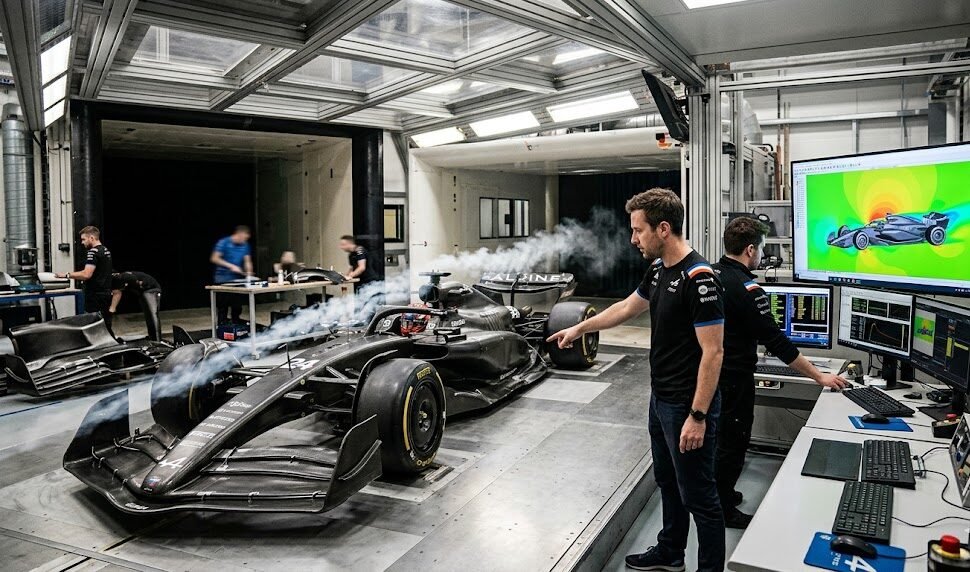
HALOSUMUT AUTONET – Modern motorsport is no longer won solely by the driver with the fastest reflexes or the engine with the most horsepower. Behind every championship-winning car lies a sophisticated engineering operation where aerodynamics, computational simulations, and continuous vehicle development play a crucial role.
In 2026, motorsport engineering has evolved into one of the most advanced fields in automotive technology. Racing teams invest millions of dollars into research and development programs designed to extract every possible fraction of performance from their vehicles.
From Formula racing and endurance competitions to touring car championships, engineering innovation remains the foundation of success on the track.
Aerodynamics: The Invisible Weapon
Aerodynamics has become one of the most important aspects of race car design.
While casual fans often focus on engine performance, engineers understand that controlling airflow around a vehicle can dramatically influence lap times. The goal is simple: maximize downforce while minimizing drag.
Downforce pushes the car onto the track surface, allowing drivers to carry more speed through corners without losing grip.
At the same time, excessive aerodynamic resistance can reduce straight-line speed, forcing engineers to strike a delicate balance.
This challenge has become increasingly complex as racing regulations continue to evolve.
Understanding Downforce and Drag
Every race car generates two critical aerodynamic forces:
| Aerodynamic Factor | Function |
|---|---|
| Downforce | Increases tire grip and cornering speed |
| Drag | Resists forward movement and reduces top speed |
| Airflow Management | Optimizes vehicle stability |
| Ground Effect | Creates additional underbody downforce |
| Wake Control | Reduces turbulent air behind vehicles |
Successful race car development focuses on maximizing beneficial aerodynamic effects while minimizing negative consequences.
Even small improvements can result in significant performance gains over an entire race season.
CFD Has Revolutionized Motorsport Development
One of the most important tools in modern motorsport engineering is Computational Fluid Dynamics (CFD).
CFD allows engineers to simulate airflow around a race car using powerful computer systems. Instead of building dozens of physical prototypes, teams can analyze thousands of aerodynamic configurations digitally before manufacturing components.
This technology saves time, reduces development costs, and enables faster innovation cycles.
Engineers can study airflow behavior around wings, sidepods, diffusers, and underbody structures with remarkable accuracy.
As computing power continues to improve, CFD simulations are becoming increasingly detailed and realistic.
Wind Tunnels Still Play a Critical Role
Despite advances in CFD technology, wind tunnel testing remains a cornerstone of race car development.
Wind tunnels provide real-world validation of simulation data by exposing scale models or full-size vehicles to controlled airflow conditions.
Engineers use these facilities to verify aerodynamic performance and identify discrepancies between virtual models and physical results.
Most top-tier motorsport teams combine CFD simulations with wind tunnel testing to create the most accurate development process possible.
The combination of digital and physical testing has become the industry standard.
The Race Car Development Process
Developing a competitive race car requires collaboration across multiple engineering disciplines.
The process typically includes:
Concept Design
Engineers establish performance objectives based on regulations and competitive benchmarks.
Aerodynamic Simulation
CFD software evaluates airflow behavior and identifies opportunities for improvement.
Structural Engineering
Materials specialists design lightweight yet durable components capable of withstanding extreme racing conditions.
Wind Tunnel Validation
Prototype designs undergo physical testing to confirm simulation results.
Track Testing
Drivers and engineers evaluate performance under real racing conditions.
Continuous Upgrades
Development continues throughout the season as teams seek incremental performance gains.
This cycle often repeats dozens of times during a championship campaign.
Materials Science Is Equally Important
Aerodynamics may attract the most attention, but materials engineering is another critical aspect of motorsport development.
Modern race cars rely heavily on advanced composites, particularly carbon fiber.
These materials offer exceptional strength while maintaining minimal weight, allowing engineers to improve acceleration, braking, and handling performance.
Many technologies first developed for motorsport eventually find their way into production vehicles, including lightweight chassis structures and advanced safety systems.
As sustainability becomes increasingly important, teams are also exploring recyclable composites and environmentally friendly manufacturing processes.
Data Analytics Drives Performance
Today’s race cars generate enormous amounts of data during every session.
Sensors monitor:
- Tire temperatures
- Suspension movement
- Aerodynamic loads
- Fuel consumption
- Engine performance
- Driver inputs
Engineers analyze this information in real time to optimize vehicle setup and race strategy.
Artificial intelligence and machine learning systems are increasingly being used to identify performance trends that may not be immediately visible through traditional analysis methods.
Data-driven decision-making has become a major competitive advantage.
How Motorsport Influences Road Cars
Many automotive innovations originally developed for racing eventually reach consumer vehicles.
Examples include:
- Carbon fiber construction
- Advanced braking systems
- Hybrid powertrains
- Active aerodynamics
- Energy recovery systems
- High-efficiency engines
Automakers often use motorsport as a testing ground for emerging technologies before introducing them into commercial products.
This technology transfer helps explain why manufacturers continue investing heavily in racing programs despite the significant costs involved.
The lessons learned on the racetrack frequently improve safety, efficiency, and performance for everyday drivers.
Sustainability Is Becoming a New Engineering Challenge
In recent years, motorsport organizations have placed greater emphasis on sustainability.
Engineers are now tasked with developing race cars that deliver exceptional performance while reducing environmental impact.
This shift has accelerated research into:
- Sustainable fuels
- Hybrid propulsion systems
- Energy recovery technologies
- Lightweight materials
- Carbon-neutral manufacturing
Many experts believe future racing championships will serve as laboratories for next-generation mobility solutions.
As a result, motorsport engineering is becoming increasingly relevant to the broader automotive industry.
Career Opportunities in Motorsport Engineering
The growth of motorsport technology has created demand for specialists in several areas:
| Engineering Discipline | Key Focus |
|---|---|
| Aerodynamics | Airflow optimization |
| CFD Analysis | Virtual simulations |
| Vehicle Dynamics | Handling performance |
| Data Engineering | Telemetry analysis |
| Powertrain Development | Engine and hybrid systems |
| Materials Science | Lightweight construction |
Universities and technical institutes worldwide are expanding motorsport-focused engineering programs to meet industry demand.
For aspiring engineers, motorsport remains one of the most exciting and technically challenging career paths available.
The Future of Motorsport Engineering
Looking ahead, the integration of artificial intelligence, advanced simulation software, and sustainable technologies is expected to transform race car development even further.
Future race cars may feature adaptive aerodynamic systems, smarter energy management strategies, and increasingly autonomous engineering processes.
While driver skill will always remain an essential component of racing success, the role of engineering innovation continues to grow.
In modern motorsport, championships are often won as much in design offices and simulation labs as they are on race day itself.
Conclusion
Motorsport engineering has evolved into a highly sophisticated discipline where aerodynamics, CFD simulations, materials science, and data analytics work together to create faster and more efficient race cars.
As teams continue searching for competitive advantages, innovation remains at the heart of every development program. From wind tunnels to artificial intelligence, the technologies shaping modern racing are also influencing the future of the automotive industry.
For fans and aspiring engineers alike, understanding the science behind race car development offers a fascinating glimpse into one of the world’s most advanced technological arenas.

1 Comment
Pingback: Electric Motorsport Technology: Batteries, Powertrains, and the Future of Racing - Halosumut AutoNet