


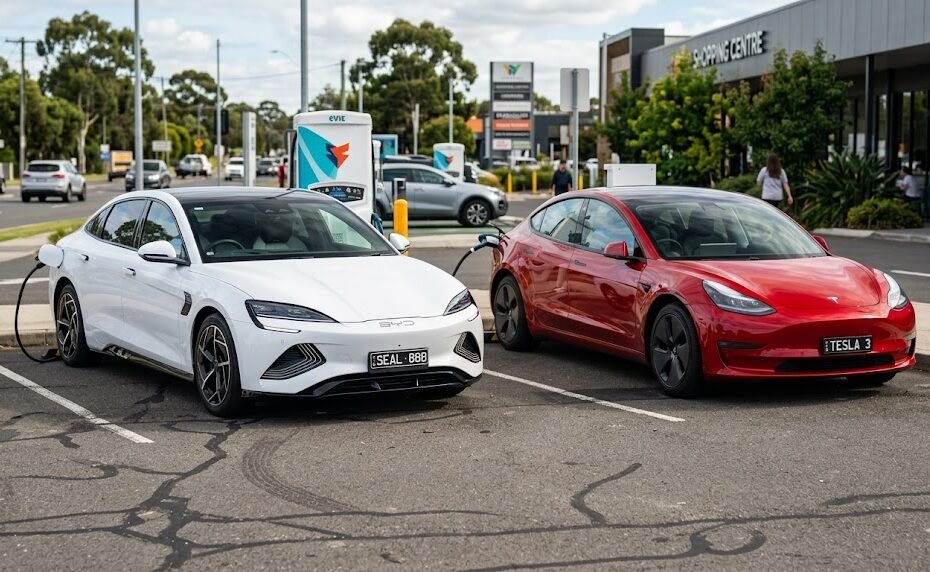
AUTOTALK – Electric vehicle buyers were primarily concerned with range, acceleration, and futuristic technology. Owning an EV was often associated with innovation and environmental consciousness. In 2026, however, a different question is increasingly influencing purchasing decisions: how much does the vehicle cost to own over several years?
This shift is fueling one of the most fascinating rivalries in the electric vehicle market—the battle between the BYD Seal and the Tesla Model 3. Both vehicles offer impressive performance, advanced technology, and competitive driving ranges. Yet for many consumers, the deciding factor is no longer horsepower or software features. It is total ownership cost.
As EV adoption enters a more mature phase, buyers are becoming increasingly analytical. They are comparing charging expenses, insurance premiums, maintenance requirements, depreciation rates, and financing costs before signing a purchase agreement.
The result is a new kind of competition that could reshape the global EV industry.
Why Ownership Costs Matter More Than Ever
The first wave of EV buyers often consisted of early adopters who prioritized innovation.
Today’s buyers are different.
Many are mainstream consumers replacing traditional gasoline vehicles. They approach EV purchases with practical financial considerations and long-term budgeting strategies.
A vehicle’s sticker price may attract attention, but ownership costs determine overall value.
Consumers now understand that an affordable purchase price can become expensive if insurance costs are high, resale values decline rapidly, or maintenance expenses unexpectedly increase.
This broader financial perspective is changing how electric vehicles are evaluated.
Meet the Contenders
The BYD Seal has emerged as one of the strongest challengers to Tesla’s dominance in the global EV market.
Manufactured by BYD, the Seal combines modern design, competitive battery technology, and aggressive pricing strategies. The vehicle has gained popularity in Asia, Europe, and several emerging EV markets.
Meanwhile, the Tesla Model 3 remains one of the world’s most recognizable electric vehicles.
Produced by Tesla, the Model 3 helped bring EVs into the mainstream and continues to benefit from a strong brand reputation, software ecosystem, and extensive charging infrastructure.
Both vehicles target similar customer segments, making direct comparisons inevitable.
Breaking Down the Ownership Cost Equation
Ownership costs extend far beyond the purchase price.
Key factors include:
- Initial vehicle cost
- Financing expenses
- Electricity consumption
- Insurance premiums
- Maintenance requirements
- Tire replacement
- Depreciation
- Charging infrastructure access
- Resale value
Buyers who ignore these factors may underestimate the true cost of vehicle ownership.
Industry analysts increasingly recommend evaluating total cost of ownership (TCO) over a five-year period rather than focusing solely on upfront pricing.
Case Study: A Five-Year Ownership Scenario
Imagine two professionals purchasing an EV in 2026.
One chooses the BYD Seal due to its competitive pricing, while the other selects the Tesla Model 3 because of brand familiarity and software integration.
Initially, the BYD owner enjoys lower acquisition costs. Depending on market conditions, financing payments may also be lower.
The Tesla owner, however, may benefit from stronger resale values and access to a mature charging ecosystem.
After five years, the total ownership gap could be much smaller than expected—or larger—depending on local incentives, electricity prices, insurance rates, and market demand.
This illustrates why buyers increasingly evaluate lifetime ownership expenses rather than showroom pricing alone.
The Charging Cost Factor
Electricity remains one of the strongest advantages of EV ownership.
However, charging costs vary significantly based on usage patterns.
Drivers who primarily charge at home often enjoy the lowest operating expenses. Public fast-charging users may face higher costs depending on local energy pricing.
The BYD Seal and Tesla Model 3 both offer efficient battery systems, but small differences in energy consumption can create noticeable cost variations over tens of thousands of kilometers.
Fleet operators and high-mileage drivers pay particular attention to this metric because even minor efficiency advantages can generate substantial savings over time.
Depreciation: The Hidden Cost Most Buyers Ignore
Perhaps the most overlooked ownership expense is depreciation.
A vehicle that loses value rapidly can cost significantly more than expected, regardless of low operating expenses.
Historically, Tesla vehicles have benefited from strong brand recognition and healthy resale demand. However, increasing competition from Chinese EV manufacturers is changing market dynamics.
The BYD Seal enters the market with aggressive pricing, which may help preserve value by reducing the premium initially paid by consumers.
As EV technology evolves rapidly, depreciation is becoming one of the most important factors influencing total ownership costs.
Opportunity Table: Industries Benefiting from the EV Ownership Shift
| Sector | Opportunity Level | Key Growth Driver |
|---|---|---|
| EV Manufacturing | Very High | Rising consumer adoption |
| Battery Technology | Very High | Efficiency improvements |
| Charging Networks | High | Infrastructure expansion |
| Vehicle Financing | High | EV loan demand |
| Insurance Technology | High | Data-driven pricing |
| Fleet Management | Medium-High | Cost optimization |
| Used EV Marketplaces | Medium-High | Growing resale activity |
These industries stand to benefit as consumers become more sophisticated in evaluating EV ownership economics.
A Unique Perspective: EV Buyers Are Becoming Financial Analysts
One of the most interesting developments in the EV market is the transformation of the average buyer.
Consumers are no longer simply choosing cars.
They are conducting cost-benefit analyses similar to investment decisions.
Online calculators, ownership cost simulations, financing comparisons, and resale forecasts have become standard research tools.
In many cases, buyers spend weeks evaluating long-term costs before making a purchase.
This shift represents a major evolution in consumer behavior and highlights the growing maturity of the EV industry.
Technology vs Affordability
The Tesla Model 3 continues to attract buyers through its software ecosystem, over-the-air updates, autonomous driving features, and charging network advantages.
The BYD Seal, meanwhile, emphasizes value, battery innovation, and competitive pricing.
This creates an intriguing market dynamic.
Some consumers prioritize technology leadership and ecosystem integration. Others focus on maximizing value and minimizing expenses.
Neither approach is inherently right or wrong.
Instead, purchasing decisions increasingly reflect individual financial priorities rather than simple performance comparisons.
The Global Impact of Chinese EV Competition
The rise of BYD has broader implications beyond individual vehicle comparisons.
Chinese EV manufacturers are increasing competitive pressure across global markets.
This competition is encouraging price reductions, faster innovation cycles, and greater consumer choice.
For buyers, the result is positive.
Consumers benefit from more options, better features, and stronger value propositions across multiple price segments.
The BYD Seal versus Tesla Model 3 rivalry is therefore part of a much larger transformation occurring throughout the automotive industry.
Looking Ahead
The battle between the BYD Seal and Tesla Model 3 represents more than a comparison between two electric sedans. It reflects a fundamental shift in how consumers evaluate transportation investments.
As EV adoption grows worldwide, ownership costs are becoming as important as design, performance, and technology.
Buyers increasingly want vehicles that deliver long-term value rather than simply impressive specifications.
Whether the BYD Seal ultimately wins on affordability or the Tesla Model 3 maintains its advantage through technology and brand strength, one trend is clear: the future of EV purchasing decisions will be driven by economics as much as engineering.
For consumers, that means smarter buying decisions. For automakers, it means competing not only on innovation but also on the total financial experience of ownership.
The era of evaluating electric vehicles solely by range and acceleration is ending. The age of ownership-cost competition has officially begun.
