


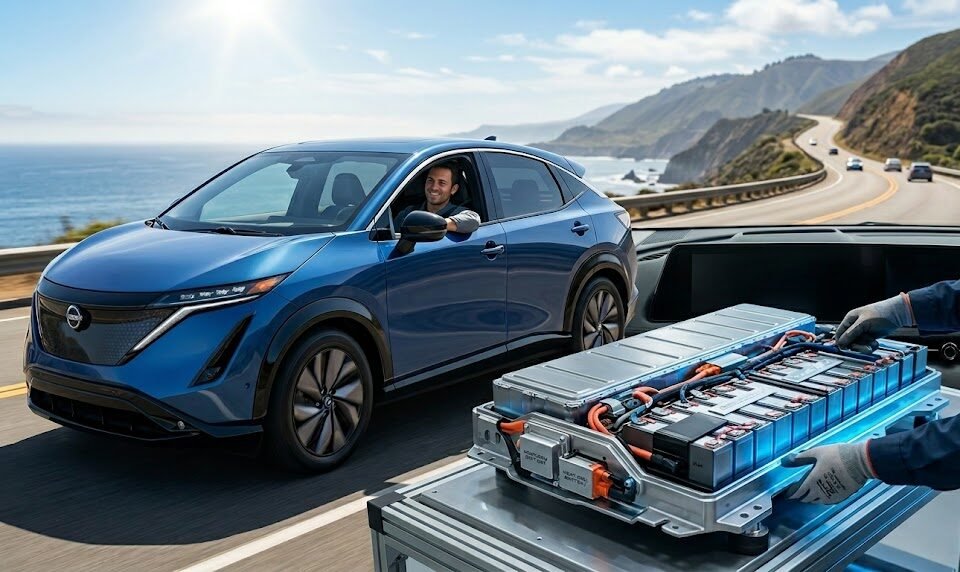
Electric vehicles have come a long way in a surprisingly short amount of time. Just a decade ago, many drivers viewed EVs as practical only for short commutes around town. Today, modern electric cars can travel hundreds of kilometers on a single charge, rivaling many gasoline-powered vehicles. Yet one challenge continues to linger in the minds of consumers: range anxiety.
Imagine driving from Jakarta to Surabaya, Bangkok to Chiang Mai, or Kuala Lumpur to Penang without worrying about finding a charging station along the way. Now imagine doing it in an electric vehicle that still has battery capacity left when you arrive.
That vision is no longer science fiction. A new generation of battery technology is being developed that could potentially add up to 1,000 kilometers of driving range, fundamentally changing how people think about electric transportation.
This breakthrough has captured the attention of automakers, battery manufacturers, investors, and governments worldwide. If these technologies reach mass production at scale, they could represent one of the most significant advancements in automotive history.
SEE ALSO >>> How Chinese EV Brands Are Reshaping Southeast Asia’s Auto Market
Why Driving Range Still Matters
Despite rapid growth in EV adoption, driving range remains one of the biggest concerns among buyers.
Many drivers compare EVs directly with gasoline vehicles. Traditional cars can often travel 600 to 900 kilometers before needing a refill, and refueling takes only a few minutes. Although charging infrastructure is expanding rapidly, some consumers still worry about long-distance travel.
This concern is especially common in regions where charging stations remain limited. Drivers want confidence that their vehicles can handle daily commuting as well as unexpected road trips.
A battery capable of delivering 1,000 kilometers of range could eliminate much of that anxiety and make EV ownership more appealing to millions of consumers.
What Is the New Battery Technology?
Several advanced battery technologies are currently competing to become the next major breakthrough. Among them, solid-state batteries are considered the most promising.
Unlike conventional lithium-ion batteries, which use liquid electrolytes, solid-state batteries use solid materials to transfer ions between electrodes. This design creates several advantages that can dramatically improve performance.
The technology allows manufacturers to increase energy density, meaning more energy can be stored within the same physical space. As a result, vehicles can travel significantly farther without increasing battery size.
Researchers believe future solid-state batteries could support ranges approaching or even exceeding 1,000 kilometers under real-world driving conditions.
How Solid-State Batteries Work
Traditional lithium-ion batteries rely on liquid electrolytes to transport lithium ions during charging and discharging.
While effective, liquid electrolytes have limitations. They can generate heat, degrade over time, and require complex safety systems to prevent thermal runaway.
Solid-state batteries replace these liquids with solid conductive materials. This approach improves energy efficiency and reduces many of the safety concerns associated with conventional batteries.
Because solid materials can support higher energy densities, manufacturers can pack more usable power into the same battery footprint, leading to substantially longer driving ranges.
The Science Behind a 1,000 KM Range
The key factor enabling longer range is energy density.
Current EV batteries typically offer energy densities between 250 and 300 watt-hours per kilogram. Emerging battery technologies are targeting densities exceeding 500 watt-hours per kilogram.
Higher energy density means a battery can store significantly more electricity without becoming larger or heavier.
As battery efficiency improves, vehicles require fewer charging stops and can travel farther on a single charge. Combined with advances in aerodynamics, software optimization, and lightweight materials, reaching 1,000 kilometers becomes increasingly realistic.
Beyond Solid-State: Other Emerging Battery Technologies
While solid-state batteries dominate headlines, they are not the only technology being developed.
Several alternatives could also contribute to ultra-long-range electric vehicles.
Lithium-Sulfur Batteries
Lithium-sulfur batteries offer the potential for much higher energy density than current lithium-ion designs.
Sulfur is abundant, inexpensive, and environmentally friendly. Researchers believe these batteries could significantly reduce manufacturing costs while extending driving range.
However, durability challenges still need to be overcome before large-scale commercialization becomes possible.
Silicon-Anode Batteries
Many battery companies are integrating silicon into battery anodes.
Silicon can store substantially more lithium ions than traditional graphite, increasing energy capacity without dramatically increasing battery size.
Several manufacturers have already begun deploying silicon-enhanced batteries in commercial EVs, making this one of the most practical near-term innovations.
Sodium-Ion Batteries
Sodium-ion technology is attracting attention because sodium is far more abundant than lithium.
Although current sodium-ion batteries generally offer lower energy density, ongoing research could make them a cost-effective alternative for specific vehicle segments.
Future hybrid battery architectures may combine multiple technologies to maximize efficiency and affordability.
Benefits of a 1,000 KM EV Battery
The impact of ultra-long-range batteries extends far beyond convenience.
Reduced Range Anxiety
One of the most obvious benefits is increased consumer confidence.
Drivers would no longer need to carefully plan every charging stop during long journeys. The experience would feel much closer to driving a conventional gasoline vehicle.
Faster EV Adoption
Many consumers remain hesitant to purchase EVs because of charging concerns.
A battery capable of traveling 1,000 kilometers could remove one of the largest psychological barriers to adoption, accelerating the transition toward electric transportation.
Lower Charging Frequency
Even drivers who rarely take long trips would benefit.
Instead of charging every few days, some users might only need to charge once a week depending on their driving habits.
Improved Commercial Transportation
Fleet operators, delivery companies, and logistics providers could gain enormous efficiency benefits.
Longer range reduces downtime and increases vehicle utilization, making electric commercial transportation more practical.
Challenges Still Standing in the Way
Despite enormous promise, several obstacles remain before 1,000-kilometer batteries become mainstream.
Manufacturing Complexity
Many next-generation battery technologies require entirely new manufacturing processes.
Building factories capable of producing advanced batteries at scale involves significant investment and technical expertise.
Cost
Early versions of breakthrough batteries will likely be expensive.
Historically, however, battery costs decline rapidly once mass production begins. Industry experts expect similar trends for future battery technologies.
Durability Testing
Automakers must prove that these batteries can withstand years of real-world use.
Consumers expect batteries to perform reliably under varying temperatures, driving conditions, and charging habits.
Extensive testing is required before large-scale deployment can occur.
Supply Chain Development
New battery chemistries often require new materials, equipment, and supplier networks.
Establishing stable supply chains is essential for achieving widespread adoption.
Which Companies Are Leading the Race?
Competition to develop next-generation batteries is intense.
Major automakers, battery manufacturers, and technology firms are investing billions of dollars in research and development.
Several industry leaders are pursuing advanced battery technologies, including:
- Toyota
- Samsung SDI
- CATL
- Panasonic
- QuantumScape
These organizations are competing to commercialize technologies that could define the next era of electric mobility.
How This Could Change the Automotive Industry
The arrival of 1,000-kilometer EV batteries could reshape the industry in ways that extend far beyond range improvements.
Consumers may begin comparing electric vehicles solely on features, performance, and design rather than battery limitations.
Governments could accelerate the phase-out of internal combustion engines.
Charging infrastructure strategies might also evolve, focusing more on convenience and ultra-fast charging rather than simply maximizing station density.
Automakers that successfully adopt next-generation batteries could gain significant competitive advantages in global markets.
The Future of Electric Mobility
The journey toward ultra-long-range EVs is already underway.
Every year brings improvements in battery chemistry, manufacturing efficiency, charging speed, and energy management software. What seemed impossible just a few years ago is quickly becoming achievable.
While challenges remain, the prospect of electric vehicles capable of traveling 1,000 kilometers on a single charge is no longer a distant dream. It represents a realistic goal that could redefine transportation for the next generation.
As battery technology continues to evolve, the distinction between electric and gasoline vehicle convenience may eventually disappear altogether.
Conclusion
The development of new battery technologies capable of delivering up to 1,000 kilometers of driving range could become one of the most transformative innovations in automotive history.
Solid-state batteries, lithium-sulfur chemistry, silicon-anode designs, and other emerging technologies are pushing the boundaries of what electric vehicles can achieve. Longer range, improved safety, lower charging frequency, and greater consumer confidence could accelerate global EV adoption faster than ever before.
Although commercialization challenges remain, industry momentum is undeniable. The race toward the 1,000-kilometer EV is no longer about whether it will happen—it is increasingly about who will get there first.
FAQ
What battery technology could enable 1,000 km of EV range?
Solid-state batteries are currently considered the leading candidate due to their high energy density, improved safety, and potential for significantly longer driving ranges.
Are solid-state batteries available today?
Limited prototypes and pilot production models exist, but widespread commercial availability is still expected within the next several years.
Will 1,000 km EVs eliminate range anxiety?
For most drivers, yes. Such ranges would exceed typical weekly driving needs and make long-distance travel much easier.
Are these new batteries safer than lithium-ion batteries?
Many next-generation battery technologies, especially solid-state batteries, are expected to offer improved safety because they eliminate flammable liquid electrolytes.
Will ultra-long-range batteries make EVs more expensive?
Initially, yes. However, costs are expected to decrease as manufacturing scales up and production processes become more efficient.
Which industries benefit besides passenger vehicles?
Commercial fleets, logistics companies, public transportation systems, and delivery services could all benefit from longer-range electric vehicles.
