


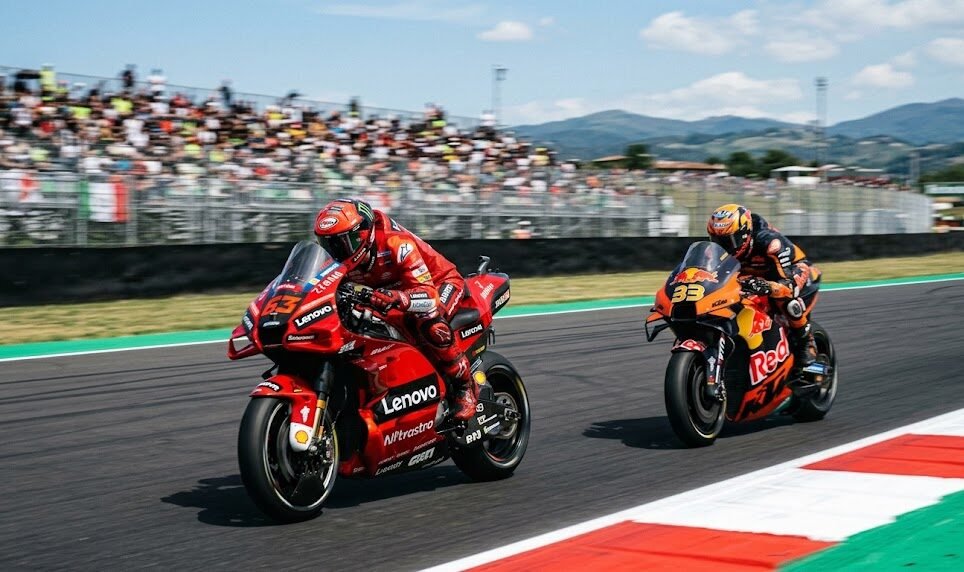
Speed has always been the heartbeat of MotoGP.
Long before data analytics, aerodynamic winglets, and advanced electronics entered the sport, motorcycle racing was fundamentally about one thing: going faster than everyone else. Every generation of engineers, riders, and manufacturers has pushed the boundaries of what is physically possible on two wheels. The result is a history filled with machines so fast that they continually redefine the limits of motorcycle performance.
Today, MotoGP motorcycles represent the pinnacle of two-wheeled engineering. These aren’t motorcycles you can buy at a dealership. They are purpose-built racing weapons designed to squeeze every possible fraction of a second from the track. Every component, from the carbon-fiber brakes to the sophisticated aerodynamics, exists for a single purpose: speed.
Over the years, some MotoGP bikes have achieved legendary status not just because they won championships, but because they shattered speed records that once seemed impossible.
Let’s take a journey through the fastest MotoGP bikes ever recorded and discover how they changed motorcycle racing forever.
The Evolution of MotoGP Speed
MotoGP speed didn’t happen overnight.
The early years of Grand Prix motorcycle racing featured machines that would seem relatively modest by today’s standards. Riders competed on motorcycles with limited power, basic suspension systems, and almost no electronic assistance.
As technology advanced, performance increased dramatically.
Engine development, tire technology, chassis design, and aerodynamics all evolved simultaneously. Every decade brought another leap forward, allowing motorcycles to travel faster while remaining controllable.
The result is astonishing.
Modern MotoGP motorcycles are capable of speeds that rival some supercars while leaning aggressively through corners at angles that appear impossible.
Breaking the 300 km/h Barrier
There was a time when reaching 300 km/h on a motorcycle seemed extraordinary.
Then MotoGP made it normal.
Manufacturers began producing increasingly powerful engines capable of pushing riders into territory previously reserved for specialized land-speed machines.
Crossing the 300 km/h threshold represented more than just a numerical achievement.
It demonstrated how far motorcycle engineering had progressed and established a new benchmark for future development.
Once the barrier was broken, teams immediately started looking for the next milestone.
That’s the nature of racing.
The Ducati Revolution
No discussion about MotoGP speed can begin without Ducati.
Over the past decade, Ducati motorcycles have become synonymous with top-speed dominance. Engineers in Bologna created machines that combine extraordinary horsepower with advanced aerodynamics and remarkable stability.
The Ducati Desmosedici platform fundamentally changed expectations.
Riders consistently achieved some of the highest speed trap figures ever recorded in MotoGP competition.
While championships require more than straight-line speed, Ducati’s ability to dominate speed charts became one of the defining stories of modern MotoGP.
Their motorcycles transformed the perception of what a racing bike could achieve.
The Legendary Ducati Desmosedici GP24
Among modern MotoGP machines, the Desmosedici GP24 stands as one of the fastest ever created.
The motorcycle combines decades of racing knowledge with cutting-edge technology.
Power delivery feels explosive, yet remarkably manageable thanks to sophisticated electronics. Aerodynamic packages generate stability at speeds that would have terrified previous generations of riders.
On long straights, the GP24 demonstrates why Ducati continues leading the speed conversation.
Its performance represents the culmination of years of relentless engineering refinement.
For many experts, it is one of the most complete MotoGP motorcycles ever built.
KTM’s Rapid Rise
For years, KTM was viewed as an ambitious challenger.
Today, that perception has changed dramatically.
The Austrian manufacturer has developed motorcycles capable of competing directly with established MotoGP giants. Their RC16 platform has evolved into a genuine speed machine capable of producing impressive top-speed figures.
KTM’s aggressive development strategy has yielded remarkable results.
The company continues narrowing the gap between itself and traditional MotoGP powerhouses.
Its progress demonstrates how quickly innovation can transform competitive landscapes.
Aprilia Joins the Speed Race
Aprilia has quietly become one of MotoGP’s most fascinating success stories.
Once considered an outsider, the Italian manufacturer now produces motorcycles capable of challenging for podiums, victories, and top-speed honors.
The RS-GP combines powerful engines with sophisticated aerodynamics and exceptional handling characteristics.
Recent seasons have shown that Aprilia is no longer merely participating.
It is competing aggressively at the highest level.
Its speed achievements prove that innovation can emerge from unexpected places.
Honda’s Historic Dominance
Before Ducati’s speed revolution, Honda spent years establishing itself as MotoGP royalty.
The RC211V and later RC213V became legendary machines capable of extraordinary performance.
Honda’s engineering philosophy emphasized balance.
The motorcycles delivered impressive speed while maintaining exceptional versatility across different circuits and conditions.
Championship success often overshadowed pure speed records.
Yet Honda motorcycles consistently ranked among the fastest machines in the world.
Their influence on MotoGP history remains undeniable.
Yamaha’s Pursuit of Perfect Balance
Yamaha has traditionally approached MotoGP differently.
Rather than focusing exclusively on top speed, Yamaha prioritized cornering performance, agility, and rider confidence.
That philosophy produced some of the most successful motorcycles in racing history.
Machines like the YZR-M1 may not always dominate speed traps, but they consistently demonstrate remarkable overall performance.
Yamaha’s success illustrates an important truth.
MotoGP isn’t merely about being fastest on the straight.
It’s about being fastest over an entire race distance.
Aerodynamics Changed Everything
Perhaps no technological advancement has influenced MotoGP speed more dramatically than aerodynamics.
Modern motorcycles now feature winglets, aerodynamic fairings, and airflow-management systems that would have seemed futuristic only a decade ago.
These innovations increase stability during acceleration and braking.
More importantly, they allow riders to utilize greater levels of engine performance safely.
The motorcycles remain planted even as speeds continue increasing.
Aerodynamics has become one of the sport’s most important competitive battlegrounds.
The Role of Electronics
MotoGP motorcycles generate immense power.
Managing that power effectively requires sophisticated electronics.
Traction control systems, engine braking management, launch control, and ride-height devices all contribute to modern performance.
Without these technologies, achieving current speed levels would be considerably more difficult.
Electronics don’t eliminate rider skill.
Instead, they allow riders to extract maximum performance while maintaining control.
The partnership between human talent and digital intelligence defines modern MotoGP.
The Fastest Speed Ever Recorded
MotoGP’s speed records continue evolving.
In recent seasons, motorcycles have exceeded 360 km/h during official race weekends, a figure once considered almost unimaginable.
These achievements result from countless hours of development.
Engineers refine engines, optimize aerodynamics, improve tires, and analyze data relentlessly.
Every kilometer per hour matters.
Every advantage counts.
The pursuit of speed remains endless.
And every record eventually becomes a target.
Why MotoGP Bikes Are Faster Than Ever
Several factors contribute to modern speed increases.
Engine technology has advanced significantly. Aerodynamics have become dramatically more effective. Tire manufacturers continue delivering improved grip and durability.
Meanwhile, data analysis allows teams to identify opportunities that previous generations could never detect.
The motorcycles themselves are extraordinary.
Yet the systems supporting them are equally impressive.
Modern MotoGP is as much a technological competition as it is a sporting contest.
Can MotoGP Bikes Get Even Faster?
The answer is almost certainly yes.
History teaches us never to underestimate engineers.
Every time observers believe MotoGP has reached its limits, new innovations emerge.
Future developments may involve advanced materials, improved aerodynamics, smarter electronics, or entirely new engineering approaches.
Regulations will influence the pace of progress.
But the pursuit of speed will never disappear.
It’s woven into the DNA of motorcycle racing.
The Human Factor Remains Essential
Despite incredible technology, MotoGP ultimately remains a human sport.
The fastest motorcycle means little without a rider capable of exploiting its potential.
Courage, precision, consistency, and adaptability continue separating champions from competitors.
At over 350 km/h, riders make decisions within fractions of a second.
They trust their instincts, training, and machines completely.
Technology may create opportunities.
Human skill transforms those opportunities into records.
Conclusion
The fastest MotoGP bikes ever recorded represent far more than impressive numbers.
They symbolize decades of innovation, relentless competition, and humanity’s endless pursuit of speed.
From Honda’s championship-winning machines and Yamaha’s balanced masterpieces to Ducati’s modern speed monsters, each generation has pushed the boundaries further.
Today’s MotoGP motorcycles are engineering marvels capable of astonishing performance levels that would have seemed impossible only a few years ago.
Yet history suggests the story is far from over.
Somewhere inside a factory, an engineer is already working on the next breakthrough.
And somewhere on a racetrack, a rider is preparing to go even faster.
Frequently Asked Questions (FAQ)
What is the fastest MotoGP bike ever recorded?
Recent Ducati Desmosedici MotoGP machines hold many of the highest speed records in modern MotoGP, with speeds exceeding 360 km/h during official race weekends.
How fast can a MotoGP bike go?
Modern MotoGP motorcycles can exceed 360 km/h under ideal conditions on circuits with long straights.
Why are Ducati MotoGP bikes so fast?
Ducati combines powerful engines, advanced aerodynamics, sophisticated electronics, and continuous development to achieve exceptional top-speed performance.
Are MotoGP bikes faster than Formula 1 cars?
MotoGP bikes can achieve comparable straight-line speeds on certain circuits, but Formula 1 cars are generally much faster overall due to superior cornering performance.
What role do winglets play in MotoGP?
Winglets improve aerodynamic stability, reduce wheelies during acceleration, and help riders maintain control at extremely high speeds.
Will MotoGP bikes continue getting faster?
Most likely, yes. Advances in engineering, aerodynamics, electronics, and materials science will continue pushing performance boundaries in the future.
