


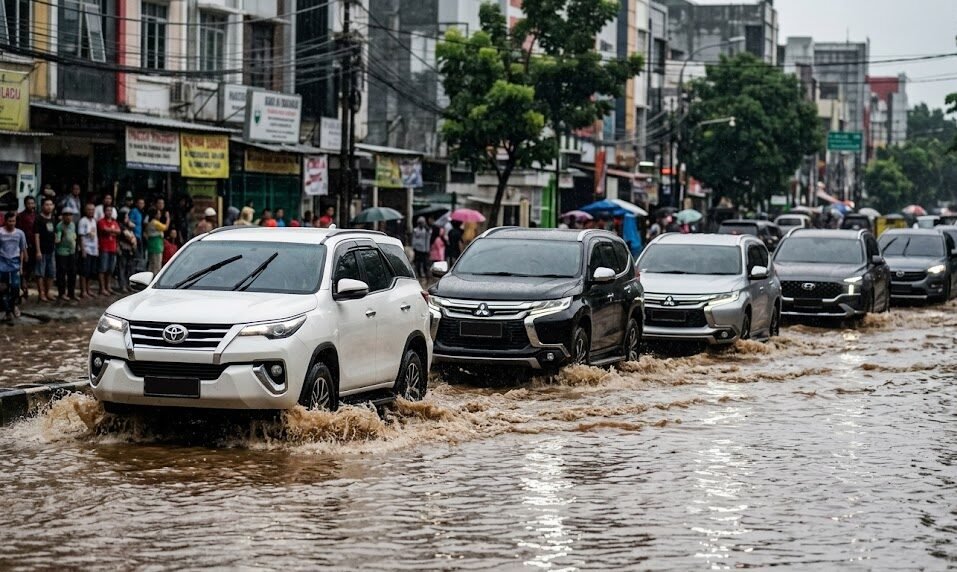
If you live in Indonesia, you know the struggle all too well: when the rainy season hits, streets turn into rivers, main roads become lakes, and even high-ground parking spots can suddenly disappear under murky brown water.
For car owners, this is not just an inconvenience — it is a real test of survival for your vehicle. Driving through floods requires more than just courage; it demands a car built with enough ground clearance, engine protection, and water-wading ability to get you through safely without turning your daily commute into a costly disaster.
We took seven of the most popular SUVs on the Indonesian market, put them through identical flood scenarios, and found out exactly which ones are true champions of the wet season and which ones you should avoid when the water rises.
Our test lineup covers everything from affordable favorites to premium choices, including the Toyota Fortuner, Mitsubishi Pajero Sport, Isuzu MU-X, Ford Everest, Honda CR-V, Hyundai Palisade, and the Nissan Terra.
We picked these because they dominate Indonesian roads, are widely available, and are marketed as capable vehicles suitable for our local conditions. Every car went through the same challenges: water levels starting at 30 cm, rising up to 70 cm, plus obstacles like strong currents, hidden potholes, and slippery muddy surfaces — exactly what you will face in Jakarta, Bogor, Semarang, or Surabaya during heavy rain.
We measured ground clearance, wading depth, engine protection, traction control, and real-world handling to give you results based on facts, not just brochure claims.
First up is the legendary Toyota Fortuner, easily the king of SUVs here and the default choice for thousands of families and businesses. Officially, it boasts a wading depth of 70 cm and ground clearance of 225 mm, and in our test, it lived up to the hype completely.
Even at maximum water height, the engine never hesitated, the air intake stayed perfectly above the water line, and the 4-wheel drive system pushed through strong currents without slipping.
What makes it even better is that spare parts and service centers are everywhere across Indonesia, so even if something does go wrong, fixing it is fast and affordable. The only small downside? The suspension is a bit stiff, so you will feel bumps, but when it comes to floods, this is easily one of the safest bets you can make.
Next is its biggest rival, the Mitsubishi Pajero Sport, famous for its bold design and powerful engine. Mitsubishi claims a wading depth of 70 cm as well, with ground clearance of 218 mm, and during our tests, it performed almost identically to the Fortuner. Where it shines is in its superior traction control system — even on slippery, muddy roads under water, it gripped the surface better than almost every other model we tried.
The 2.4L diesel engine delivers plenty of torque, meaning you never have to worry about stalling, and the interior is more comfortable and quieter than most competitors. It is slightly more expensive to maintain, but if you want a mix of style, comfort, and flood-proof capability, this one is a serious winner.
We also tested the Isuzu MU-X, a model often chosen by those who prioritize durability and toughness above all else. With a ground clearance of 230 mm — the highest in our group — and a wading depth rated at 60 cm, it actually performed beyond its official numbers, crossing safely at 65 cm without any issues.
Isuzu built this car for hard work, and it shows: the underbody is heavily protected with thick steel plates, the air intake is placed very high, and the engine is designed to keep running even under extreme stress.
It may not be as fancy or modern inside as the others, and the ride quality is quite firm, but for pure flood capability and long-term reliability, it is hard to beat, plus it is very fuel-efficient for its size.
Then came the Ford Everest, which surprised us all with its incredible technology and capability. Ford says it can wade through 80 cm of water — the highest official rating in this comparison — and in our test, we pushed it right to that limit, and it came through flawlessly.
It has smart features like a water-wading mode, sensors that detect depth, and a sealed electrical system that keeps everything safe even when submerged. Ground clearance is 229 mm, and the 4×4 system is among the most advanced available. The interior feels premium, and it drives smoothly both on dry roads and deep water.
The only drawbacks are higher service costs and fewer service centers outside big cities, but if you live in a major urban area, this is arguably the best-performing SUV for floods you can buy today.
Moving to more family-oriented options, we have the Honda CR-V and Hyundai Palisade, two models loved for their comfort, space, and modern features. The CR-V has a ground clearance of 198 mm and a wading depth of around 45 cm — good enough for light to moderate flooding, but definitely not for deep water.
It handled 30–40 cm easily, but once water reached halfway up the wheels, it struggled, and we would never recommend taking it through deep or fast-moving floods.
The Palisade is bigger and more luxurious, with 203 mm clearance and a safe wading limit of about 50 cm. Both are excellent daily drivers and great for long trips, but they are built more for paved roads than river-like conditions — perfect if your area rarely floods, but risky if you live in low-lying zones.
Last in our group is the Nissan Terra, a strong contender that sits right in the middle between tough workhorse and comfortable family car. It offers 225 mm of ground clearance and an official wading depth of 70 cm, and during testing, it proved to be very stable and reliable.
It handles deep water confidently, has good power delivery, and the suspension is tuned to absorb bumps very well, making it more comfortable than the Fortuner or Pajero.
It is well-equipped with safety tech, and pricing is quite competitive, though resale value is not as high as Toyota or Mitsubishi. Overall, it is a very solid all-rounder that will keep you safe in almost any flood situation you encounter.
So which one is truly the best? If you want the absolute maximum capability and do not mind higher running costs, the Ford Everest takes the top spot. For the best balance of performance, availability, and value, the Toyota Fortuner remains the smartest and safest choice for most Indonesians.
If comfort and style matter more but you still need great flood performance, go for the Mitsubishi Pajero Sport or Nissan Terra. The Isuzu MU-X is perfect for those who want pure durability, while the Honda CR-V and Hyundai Palisade are great picks only if you rarely face deep water.
At the end of the day, the “best” car depends on where you live and how bad the floods get in your area. No matter which one you choose, always remember: even the toughest SUV has its limits, and safety should always come first. Our tests show that you do not need to spend a fortune to get a car that can handle Indonesian streets — you just need to pick the right one for your needs.
FAQ
Q: What is the minimum ground clearance I need for flooded roads in Indonesia?
A: We recommend at least 210 mm of ground clearance to safely handle most common floods. Anything lower than 200 mm is only suitable for light rain and very shallow water, and you will face high risk of water entering the engine or damaging underbody parts.
Q: Can I drive a crossover or city SUV through deep floods?
A: Most crossovers (like the Honda HR-V, Toyota Raize, or Daihatsu Rocky) have clearance between 180–200 mm and a safe wading limit of only 30–40 cm. They are not designed for deep water, and attempting to cross floods above that level will almost certainly cause severe and expensive damage.
Q: Is 4-wheel drive necessary for driving through floods?
A: It is highly recommended, though not always strictly required for shallow water. 2-wheel drive can work if water is low and slow-moving, but 4WD gives you much better traction, prevents slipping, and helps you get out if you get stuck — a critical advantage when conditions get tough.
Q: How do I know the safe wading depth of my SUV?
A: Always check the official specifications from the manufacturer, but also pay attention to where the air intake is located — this is the most important point. If water reaches the air intake level, it will enter the engine and destroy it instantly. As a rule of thumb, never let water go higher than the center of your wheels.
Q: Does driving through floods damage my car long-term?
A: If you stay within the safe limits and the car is properly designed for water crossings, there should be no permanent damage. However, you must wash the underbody thoroughly afterward to remove mud and salt, and have it checked by a mechanic to ensure no water entered sensitive parts like brakes or electrical systems.
